
Wisdom Teeth Removal in Daly City, San Francisco & the Bay Area
Removal of impacted or problem wisdom teeth in our Daly City office, with IV sedation/general anesthesia available.
Wisdom Teeth Removal in Daly City, San Francisco & the Bay Area
Expert Third Molar Removal by a Board-Certified Oral & Maxillofacial Surgeon
At Archstone Oral & Facial Surgery, we provide advanced wisdom teeth removal in Daly City, San Francisco, and throughout the Bay Area. Wisdom teeth — also called third molars — are the final set of adult teeth to develop and typically appear between ages 16 and 25.
While some patients never experience problems, many do not have enough space in their jaw to accommodate these teeth. When wisdom teeth become impacted, infected, or misaligned, they can lead to pain, swelling, jaw stiffness, damage to neighboring teeth, and even cyst formation.
Early evaluation allows us to prevent complications before they become more serious and more costly to treat.
Wisdom Teeth Removal at a Glance
| Question | Quick answer |
|---|---|
| Best age for removal | Mid-teens to mid-20s, before roots fully form |
| Surgery time | 30–60 minutes for all four |
| Anesthesia options | Local, nitrous oxide, oral sedation, or IV sedation/general anesthesia |
| Back to school or work | 2–4 days for most patients |
| Full healing | 1–2 weeks; sockets close over the following weeks |
| Follow-up | Post-op visit about 1 week after surgery |
| Ride home | Required after any sedation |
| Insurance | Most dental plans cover part — we verify benefits first |
Why Wisdom Teeth Often Need to Be Removed
Modern jaws are often too small to properly fit third molars. When there isn’t adequate space, wisdom teeth may:
- Grow at an angle toward adjacent teeth
- Remain trapped beneath the gums or bone
- Partially erupt, creating a pocket for bacteria
- Cause crowding of otherwise straight teeth
- Lead to infections such as pericoronitis
Proactive removal during the late teens or early twenties generally results in an easier procedure and faster recovery.
Types of Impacted Wisdom Teeth
When wisdom teeth cannot erupt normally, they are classified as impacted. The level of impaction affects surgical complexity and recovery time.
Soft Tissue Impaction
- What It Means: The tooth has partially erupted but remains covered by gum tissue.
- Common Risks: Infection, gum inflammation, and difficulty cleaning the area.
- Treatment: Surgical removal to prevent recurring infection.
Partial Bony Impaction
- What It Means: The tooth is partially trapped beneath the jawbone.
- Common Risks: Infection, decay of adjacent teeth, bone loss.
- Treatment: Surgical extraction with careful bone management.
Complete Bony Impaction
- What It Means: The tooth is fully encased within the jawbone.
- Common Risks: Cyst formation, nerve pressure, damage to neighboring teeth.
- Treatment: Advanced surgical removal using precision techniques.
Your Consultation & Digital Diagnosis
Your evaluation includes a comprehensive exam and digital panoramic X-ray (Panorex) to determine:
- Position and angulation of the wisdom teeth
- Relationship to the inferior alveolar nerve
- Presence of infection or pathology
- Optimal timing for removal
We use modern surgical planning techniques to ensure precision, safety, and minimal discomfort.
Anesthesia & Comfort Options
Your comfort is our priority. We offer:
- Local anesthesia
- Nitrous oxide
- Oral sedation
- IV sedation/general anesthesia
Our team will review your medical history and recommend the safest and most comfortable option for your procedure.
Wisdom Teeth Recovery: What to Expect
Most patients return to school or work within a few days. Normal recovery signs include:
- Gradually decreasing swelling and discomfort
- Mild stiffness that improves daily
- Minor oozing during the first 24 hours
Detailed post-operative instructions are provided to ensure smooth healing. View Post-Operative Instructions.
When to Contact Our Office
Call our Daly City office immediately if you experience:
- Severe or worsening pain after 3–4 days
- Signs of infection (fever, foul taste, increasing swelling)
- Persistent bleeding
- Numbness lasting longer than expected
Cost of Wisdom Teeth Removal in the Bay Area
The cost of wisdom teeth removal varies depending on the level of impaction and type of anesthesia used. Many dental insurance plans provide partial coverage. Our team will review your benefits and discuss financing options prior to treatment.
Learn more about insurance coverage here: Insurance & Financial Information
Wisdom Teeth FAQs
Why should an oral surgeon remove wisdom teeth instead of a general dentist?
Oral and maxillofacial surgeons complete four to six years of hospital-based surgical and anesthesia residency after dental school, which is why general dentists routinely refer impacted wisdom teeth to a specialist. Dr. Dela Rosa manages impactions near the nerve, offers IV sedation and general anesthesia in the office, and handles complications that can arise during surgery.
What is the best age to have wisdom teeth evaluated and removed?
Most patients are first evaluated in their mid-teens with a panoramic X-ray or 3D CBCT scan. Removal is usually simpler in the late teens or early twenties, before the roots fully develop and the bone becomes denser — which is why AAOMS recommends an evaluation by early adulthood.
How do I know if a wisdom tooth is impacted or needs urgent care?
Common signs include pain or pressure at the back of the jaw, a swollen or inflamed gum flap over a partially erupted tooth (pericoronitis), jaw stiffness, and a persistent bad taste. Fever, facial swelling, or difficulty swallowing are urgent — call our office the same day at (415) 963-4121.
Do you have 3D imaging (CBCT) in the office?
Yes. We use in-house cone-beam CT (CBCT) imaging to map each wisdom tooth in three dimensions relative to the nerve and sinus, so surgical planning and the consultation can happen in a single visit.
Schedule Your Wisdom Teeth Consultation
If you or your teen need wisdom teeth removal in Daly City, San Francisco, or the greater Bay Area, we are here to help. Early evaluation can prevent painful complications and protect your long-term oral health.
Call today to schedule your consultation.
Additional Educational Resources
Back to Top
Wisdom Teeth — At a Glance
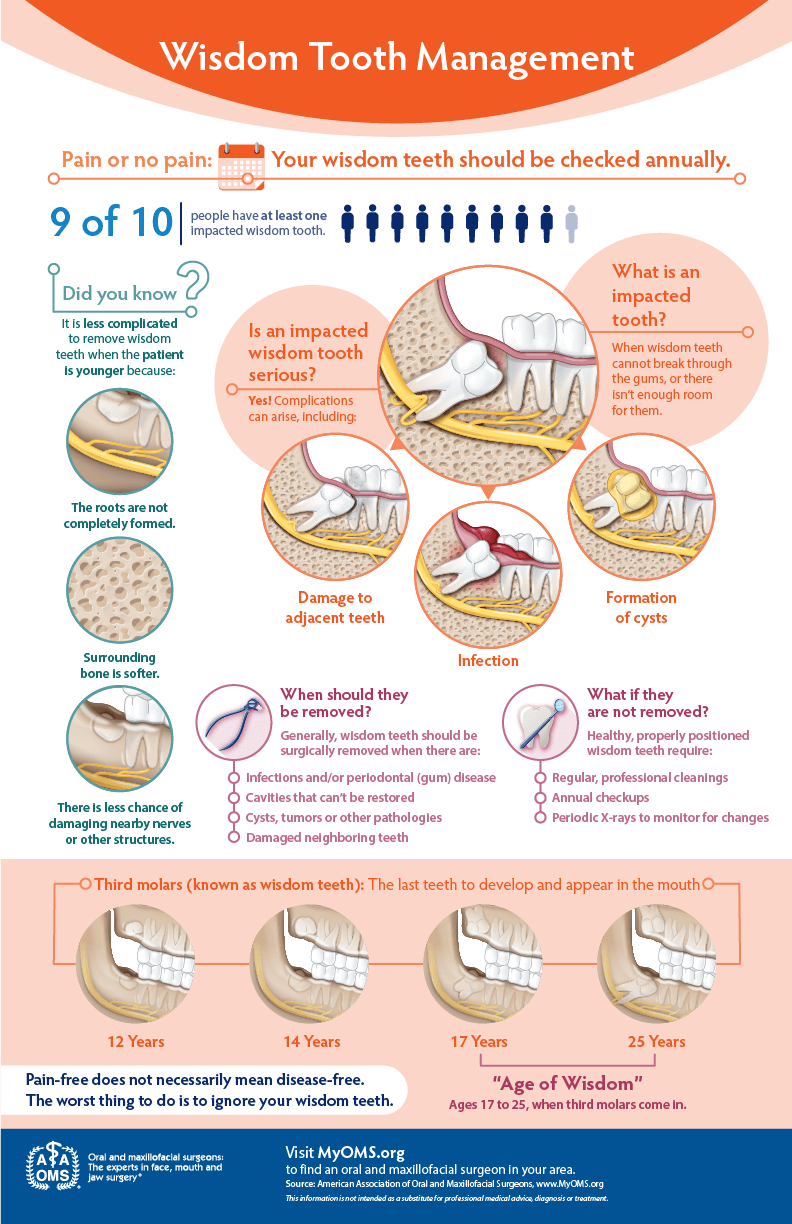
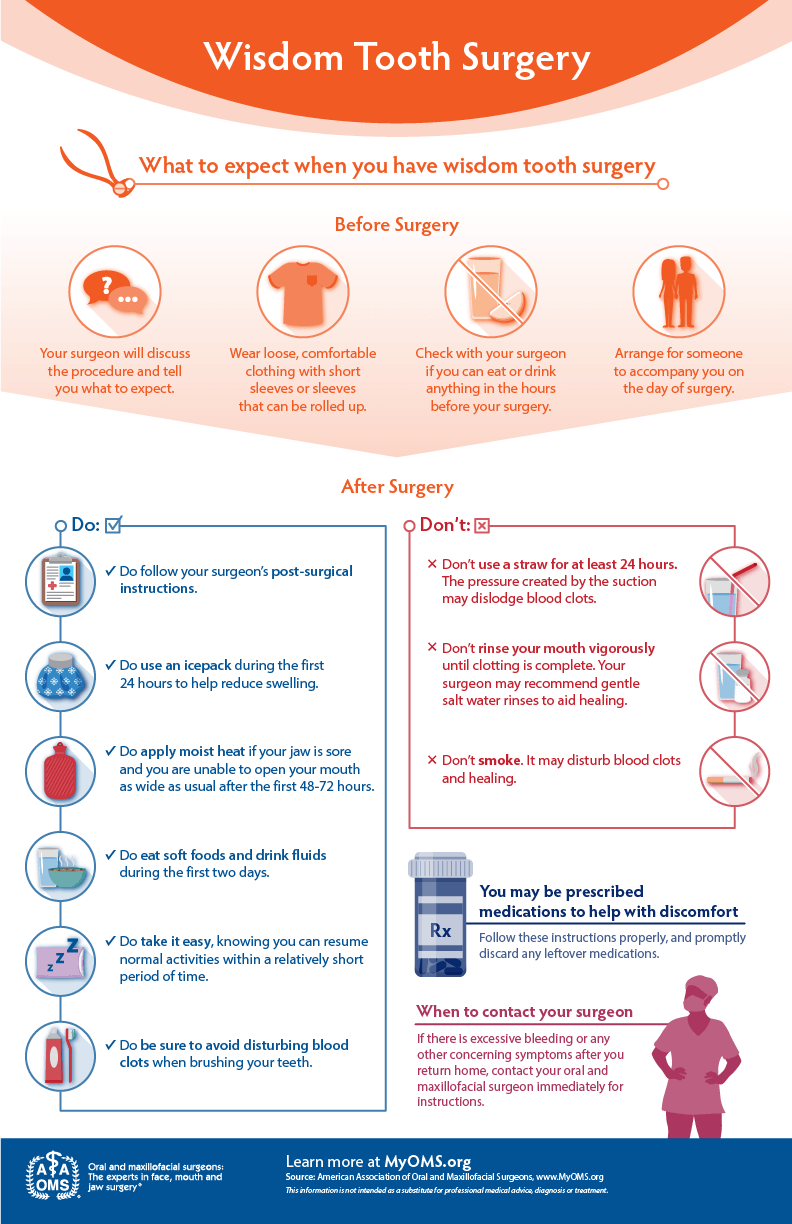
Infographic courtesy of the American Association of Oral and Maxillofacial Surgeons (AAOMS). Dr. Dela Rosa is an AAOMS member.
Patient Education Video
Common questions
Do wisdom teeth always need to be removed?
Will I be asleep during the procedure?
How long does recovery take?
What is dry socket and how do I avoid it?
Do I need a referral from my dentist?
What to expect
- Procedure time
- 30–60 min for all four
- Anesthesia
- Local, nitrous, oral, or IV sedation/general anesthesia
- Back to normal activity
- 2–4 days
- Full healing
- 1–2 weeks
- Follow-up
- Post-op visit in about 1 week
- Insurance
- Most dental plans cover part; we verify benefits first
Ready to talk it through?
Call us or request an appointment. Referred by your dentist? Bring the referral and we'll take it from there.